
Loading...
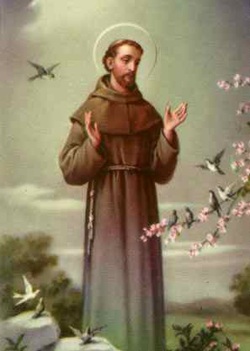
Saint Francis of Assisi (born Giovanni Francesco di Bernardone; 1181 – died: October 3, 1226) He founded men's Franciscan Order, the women’s Order of St. Clare, and the lay Third Order of Saint Francis. Though he was never ordained into the Catholic priesthood, Francis is one of the most venerated religious figures in history.
Francis was the son of a wealthy cloth merchant in Assisi, and he lived the high-spirited life typical of a wealthy young man, even fighting as a soldier for Assisi. While going off to war in 1204, Francis had a vision that directed him back to Assisi, where he lost his taste for his worldly life. On a pilgrimage to Rome, he begged with the beggars at St. Peter's. The experience moved him to live in poverty. Francis returned home, began preaching on the streets, and soon amassed a following. His order was endorsed by Pope Innocent III in 1210. He then founded the Order of Poor Clares, which was an enclosed order for women, as well as the Third Order of Brothers and Sisters of Penance. In 1219, he went to Egypt in an attempt to convert the Sultan. By this point, the Franciscan Order had grown to such an extent that its primitive organizational structure was no longer sufficient. He returned to Italy to organize the order. Once his organization was endorsed by the Pope, he withdrew increasingly from external affairs. In 1223, Francis arranged for the first Christmas manger scene. In 1224, he received the stigmata, making him the first recorded person to bear the wounds of Christ's Passion. He died in 1226 while preaching Psalm 141.
On July 16, 1228, he was pronounced a saint by Pope Gregory IX. He is known as the patron saint of animals, the environment and one of the two patrons of Italy (with Catherine of Siena), and it is customary for churches to hold ceremonies blessing animals on his feast day of 4 October. He is also known for his love of the Eucharist, his sorrow during the Stations of the Cross and for the creation of the Christmas creche or Nativity Scene.
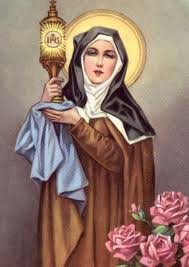
Clare of Assisi (sometimes spelled Clair, Claire, etc.) (July 16, 1194 – August 11, 1253), born Chiara Offreduccio, was one of the first followers of Saint Francis of Assisi.
Clare was born in Assisi, Italy, as the eldest daughter of Favorino Scifi, Count of Sasso-Rosso and his wife Ortolana. Ortolana was a very devout woman who had undertaken pilgrimages to Rome, Santiago de Compostela and the Holy Land. Later on in her life, Ortolana entered Clare's monastery, together with Agnes, Clare's sister.
Clare and her sister Agnes soon moved to the church of San Damiano, which Francis himself had rebuilt. Other women joined them there, and San Damiano became known for its radically austere lifestyle. The women were at first known as the "Poor Ladies". She founded the Order of Poor Ladies, a monastic religious order for women in the Franciscan tradition, and wrote their Rule of Life—the first monastic rule known to have been written by a woman.
San Damiano became the focal point for Clare's new religious order, which was known in her lifetime as the "Order of San Damiano". San Damiano emerged as the most important house in the order, and Clare became its undisputed leader. By 1263, just ten years after Clare's death, the order had become known as the Order of Saint Clare.
For a short period of time the order was directed by Francis himself. Then in 1216, Clare accepted the role of abbess of San Damiano. As abbess, Clare had more authority to lead the order than when she was the prioress, who had to follow the orders of a priest heading the community. Clare defended her order from the attempts of prelates to impose a rule on them that more closely resembled the Rule of Saint Benedict than Francis' stricter vows. Clare sought to imitate Francis' virtues and way of life so much so that she was sometimes titled alter Franciscus, another Francis. She also played a significant role in encouraging and aiding Francis, whom she saw as a spiritual father figure, and she took care of him during his illnesses at the end of his life, until his death in 1226.
On August 9, 1253, the papal bull Solet annuere of Pope Innocent IV confirmed that Clare's rule would serve as the governing rule for Clare's Order of Poor Ladies. Two days later, on August 11, Clare died at the age of 59. Her remains were interred at the chapel of San Giorgio while a church to hold her remains was being constructed.
On August 15, 1255, Pope Alexander IV canonized Clare as Saint Clare of Assisi. Construction of the Basilica of Saint Clare was completed in 1260, and on October 3 of that year Clare's remains were transferred to the newly completed basilica where they were buried beneath the high altar. In further recognition of the saint, Pope Urban IV officially changed the name of the Order of Poor Ladies to the Order of Saint Clare in 1263.
Some 600 years later in 1872, Saint Clare's remains were transferred to a newly constructed shrine in the crypt of the Basilica of Saint Clare where they can still be seen today.
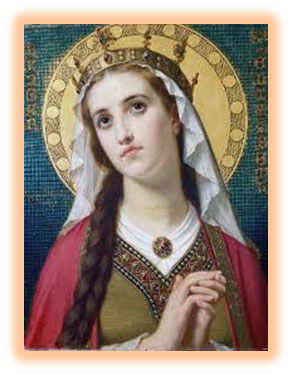
Elizabeth of Hungary, T.O.S.F., (German: Heilige Elisabeth von Thüringen, Hungarian: Árpád-házi Szent Erzsébet, 7 July 1207 – 17 November 1231)
Elizabeth was the daughter of King Andrew II of Hungary and Gertrude of Merania.
Elizabeth was brought to the court of the rulers of Thuringia in central Germany, to become betrothed to Louis IV, Landgrave of Thuringia, a future bride who would reinforce political alliances between the families. She was raised by the Thuringian court, so she would be familiar with the local language and culture.
In 1221, at the age of fourteen, Elizabeth married Louis; the same year he was enthroned as Landgrave Louis IV, and the marriage appears to have been happy. In 1223, Franciscan friars arrived, and the teenage Elizabeth not only learned about the ideals of Francis of Assisi, but started to live them. Louis was not upset by his wife's charitable efforts, believing that the distribution of his wealth to the poor would bring eternal reward; he is venerated in Thuringia as a saint, though he was never canonized by the Church.
In the spring of 1226, when floods, famine, and plague wrought havoc in Thuringia, Louis, a staunch supporter of the Hohenstaufen Frederick II, Holy Roman Emperor, represented Frederick II at the Reichstag (Imperial Diet) in Cremona. Elizabeth assumed control of affairs at home and distributed alms in all parts of their territory, even giving away state robes and ornaments to the poor. Below Wartburg Castle, she built a hospital with twenty-eight beds and visited the inmates daily to attend to them.
Elizabeth's life changed irrevocably on 11 September 1227 when Louis, en route to join the Sixth Crusade, died of a fever in Otranto, Italy. On hearing the news of her husband's death, Elizabeth is reported to have said, "He is dead. He is dead. It is to me as if the whole world died today." His remains were returned to Elizabeth in 1228 and entombed at the Abbey of Reinhardsbrunn.
After Louis' death, his brother, Henry Raspe, assumed the regency during the minority of Elizabeth's eldest child, Hermann (1222–1241). After bitter arguments over the disposal of her dowry—a conflict in which Konrad was appointed as the official Defender of her case by Pope Gregory IX—Elizabeth left the court at Wartburg and moved to Marburg in Hesse.
Following her husband's death, Elizabeth made solemn vows to Konrad similar to those of a nun. These vows included celibacy, as well as complete obedience to Konrad as her confessor and spiritual director. Konrad's treatment of Elizabeth was extremely harsh, and he held her to standards of behavior which were almost impossible to meet. Among the punishments he is alleged to have ordered were physical beatings; he also ordered her to send away her three children. Her pledge to celibacy proved a hindrance to her family's political ambitions. Elizabeth was more or less held hostage at Pottenstein, Bavaria, the castle of her uncle, Bishop Ekbert of Bamberg, in an effort to force her to remarry. Elizabeth, however, held fast to her vow, even threatening to cut off her own nose so that no man would find her attractive enough to marry.
She then built a hospital at Marburg for the poor and the sick with the money from her dowry, where she and her companions cared for them. Her official biography written as part of the canonization process describes how she ministered to the sick and continued to give money to the poor. In 1231, she died in Marburg at the age of twenty-four.
After her death Elizabeth was commonly associated with the Third Order of St. Francis, the primarily lay Franciscan branch of the Franciscan Order.
Very soon after the death of Elizabeth, miracles were reported that happened at her grave in the church of the hospital, especially miracles of healing. On the suggestion of Konrad, and by papal command, examinations were held of those who had been healed between August, 1232, and January, 1235. The results of those examinations was supplemented by a brief vita of the saint-to-be, and together with the testimony of Elizabeth's handmaidens and companions (bound in a booklet called the Libellus de dictis quatuor ancillarum s. Elizabeth confectus), proved sufficient reason for the quick canonization of Elizabeth on 27 May 1235 in Perugia.
She was canonized by Pope Gregory IX. The papal bull declaring her a saint is on display in the Schatzkammer of the Deutschordenskirche in Vienna, Austria. Her body was laid in a magnificent golden shrine—still to be seen today—in the Elisabeth Church (Marburg).
Elizabeth was the first member of the Franciscan Third Order to be declared a saint, only recently founded in 1221. From her support of the friars sent to Thuringia, she was made known to the founder, St. Francis of Assisi, who sent her a personal message of blessing shortly before his death in 1226. Upon her canonization she was declared the patron saint of the Third Order of St. Francis, an honor she shares with St. Louis IX of France.
Elizabeth is perhaps best known for the legend which says that whilst she was taking bread to the poor in secret, her husband asked her what was in the pouch; Elizabeth opened it and the bread turned into roses.
Another popular story about St. Elizabeth, also found in Dietrich of Apolda's Vita, relates how she laid a leper in the bed she shared with her husband. When Ludwig discovered what she had done, he is said to have snatched off the bedclothes in great indignation, but at that instant "Almighty God opened the eyes of his soul, and instead of a leper he saw the figure of Christ crucified stretched upon the bed."
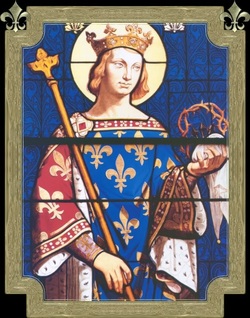
Louis was born on 25 April 1214 at Poissy, near Paris, the son of Prince Louis the Lion and Blanche of Castile, and baptized in La Collégiale Notre-Dame church. His grandfather was King Philip II of France. He was 9 years old when his grandfather died and his father ascended as Louis VIII. Louis was twelve years old when his father died on 8 November 1226. He was crowned king within the month at Reims cathedral. Because of Louis's youth, his mother ruled France as regent during his minority. He worked with the Parliament of Paris in order to improve the professionalism of his legal administration.
On 27 May 1234, Louis married Margaret of Provence (1221 – 21 December 1295).
The perception of Louis IX as the exemplary Christian prince was reinforced by his religious zeal. Louis was a devout Catholic, and he built the Sainte-Chapelle ("Holy Chapel"), located within the royal palace complex (now the Paris Hall of Justice), on the Île de la Cité in the centre of Paris. The Sainte Chapelle was erected as a shrine for the Crown of Thorns and a fragment of the True Cross, precious relics of the Passion of Jesus.
Louis IX took very seriously his mission as "lieutenant of God on Earth", with which he had been invested when he was crowned in Rheims. To fulfill his duty, he conducted two crusades, and even though they were unsuccessful, they contributed to his prestige.
Louis IX tried to fulfill the duty of France, which was seen as "the eldest daughter of the Church" (la fille aînée de l'Église), a tradition of protector of the Church going back to the Franks and Charlemagne, who had been crowned by the Pope in Rome in 800.
During his second crusade, Louis died at Tunis, 25 August 1270. As Tunis was Muslim territory, his body was subject to the process known as mos Teutonicus (a postmortem funerary custom used in mediæval Europe whereby the flesh was boiled from the body, so that the bones of the deceased could be transported hygienically from distant lands back home, for its transportation back to France. He was succeeded by his son, Philip III. Louis died from dysentery.
Christian tradition states that some of his entrails were buried directly on the spot in Tunisia, where a Tomb of Saint-Louis can still be visited today, whereas his heart and other parts of his entrails were sealed in an urn and placed in the Basilica of Monreale, Palermo, where they still remain. (Sicily was at that time ruled by his younger brother, Charles of Anjou) His corpse was taken, after a short stay at the Basilica of Saint Dominic in Bologna, to the French royal necropolis at Saint-Denis, resting in Lyon on the way. His tomb at Saint-Denis was a magnificent gilt brass monument designed in the late 14th century. It was melted down during the French Wars of Religion, at which time the body of the king disappeared. Only one finger was rescued and is kept at Saint-Denis.
Pope Boniface VIII proclaimed the canonization of Louis in 1297; he is the only French monarch to be declared a saint.
Louis IX is often considered the model of the ideal Christian monarch. Because of the aura of holiness attached to his memory, many kings of France were called Louis, especially in the Bourbon dynasty, which directly descended from one of his younger sons.
The Congregation of the Sisters of Saint Louis is a Roman Catholic religious order founded in 1842 and named in his honor.
He is also honored as co-patron of the Third Order of St. Francis.